Friday, March 2, 2007

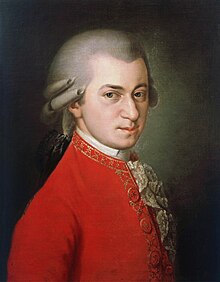
Wolfgang Amadeus Mozart

Wolfgang Amadeus Mozart (IPA: [ˈvɔlfgaŋk amaˈdɔʏs ˈmotsaɐt], baptized Johannes Chrysostomus Wolfgangus Theophilus Mozart) (January 27, 1756 – December 5, 1791) was a prolific and influential composer of the Classical era. His output of over 600 compositions includes works widely acknowledged as pinnacles of symphonic, concertante, chamber, piano, operatic, and choral music. Mozart is among the most enduringly popular of European composers and many of his works are part of the standard concert repertoire. He is generally considered to be one of the greatest composers of classical music.
Family and early years
Mozart's birthplace at Getreidegasse 9, Salzburg, Austria
Plaque on wall outside Mozart's birthplace at Getreidegasse 9, Salzburg, Austria. It reads Mozart's Birth house, Mozart Museum. In this House W.A. Mozart on 27th of January 1756 was born

Mozart was born to Leopold and Anna Maria Pertl Mozart, in the front room of Getreidegasse 9 in Salzburg, the capital of the sovereign Archbishopric of Salzburg, in what is now Austria, then part of the Holy Roman Empire. His only sibling who survived past birth was an older sister: Maria Anna, nicknamed Nannerl. Mozart was baptized the day after his birth at St. Rupert's Cathedral. The baptismal record gives his name in Latinized form as Joannes Chrysostomus Wolfgangus Theophilus Mozart. Of these names, the first two refer to John Chrysostom, one of the Church Fathers, and they were names not employed in everyday life. The fourth name, meaning "beloved of God" in Greek, was variously translated in Mozart's lifetime as Amadeus (Latin), Gottlieb (German), and Amadé (French). Mozart's father Leopold announced the birth of his son in a letter to the publisher Johann Jakob Lotter with the words "...the boy is called Joannes Chrysostomus, Wolfgang, Gottlieb". Mozart himself preferred to use the third name, and he also took a fancy to "Amadeus" over the years. (see Mozart's name).

Mozart's father Leopold Mozart (1719–1787) was one of Europe's leading musical teachers. His influential textbook Versuch einer gründlichen Violinschule, was published in 1756, the year of Mozart's birth (English, as "A Treatise on the Fundamental Principles of Violin Playing", transl. E.Knocker; Oxford-New York, 1948). He was deputy Kapellmeister to the court orchestra of the Archbishop of Salzburg, and a prolific and successful composer of instrumental music. Leopold gave up composing when his son's outstanding musical talents became evident. They first came to light when Wolfgang was about three years old, and Leopold, proud of Wolfgang's achievements, gave him intensive musical training, including instruction in clavier, violin, and organ. Leopold was Wolfgang's only teacher in his earliest years. A note by Leopold in Nannerl's music book – the Nannerl Notenbuch – records that little Wolfgang had learned several of the pieces at the age of four. Mozart's first compositions, a small Andante (K. 1a) and Allegro (K. 1b), were written in 1761, when he was five years old.[1]

[edit] The years of travel
"Bologna Mozart" - Mozart age 21 in 1777, see also: face only

During his formative years, Mozart made several European journeys, beginning with an exhibition in 1762 at the Court of the Elector of Bavaria in Munich, then in the same year at the Imperial Court in Vienna and Prague. A long concert tour spanning three and a half years followed, taking him and his father to the courts of Munich, Mannheim, Paris, London (where Wolfgang Amadeus played with the famous Italian cellist Giovanni Battista Cirri), The Hague, again to Paris, and back home via Zürich, Donaueschingen, and Munich. During this trip Mozart met a great number of musicians and acquainted himself with the works of other great composers. A particularly important influence was Johann Christian Bach, who met Mozart in London in 1764–65. Bach's work is often taken to be an inspiration for Mozart's music. They again went to Vienna in late 1767 and remained there until December 1768. On this trip Mozart contracted smallpox, and his healing was believed by Leopold as a proof of God's plans concerning the child.

After one year in Salzburg, three trips to Italy followed: from December 1769 to March 1771, from August to December 1771, and from October 1772 to March 1773. Mozart was commissioned to compose three operas: Mitridate Rè di Ponto (1770), Ascanio in Alba (1771), and Lucio Silla (1772), all three of which were performed in Milan. During the first of these trips, Mozart met Andrea Luchesi in Venice and G.B. Martini in Bologna, and was accepted as a member of the famous Accademia Filarmonica. A highlight of the Italian journey, now an almost legendary tale, occurred when he heard Gregorio Allegri's Miserere once in performance in the Sistine Chapel then wrote it out in its entirety from memory, only returning to correct minor errors; thus producing the first illegal copy of this closely-guarded property of the Vatican.[2]

On September 23, 1777, accompanied by his mother, Mozart began a tour of Europe that included Munich, Mannheim, and Paris. In Mannheim he became acquainted with members of the Mannheim orchestra, the best in Europe at the time. He fell in love with Aloysia Weber, who later broke up the relationship with him. He was to marry her sister Constanze some four years later in Vienna. During his unsuccessful visit to Paris, his mother died in 1778.
Memorial plaque dedicated to Wolfgang Amadeus Mozart in Václavské náměstí square in Olomouc (Czech Republic). Mozart in 1767 as an 11-year-old boy was fleeing from Vienna due to a smallpox epidemic and wrote his Sixth Symphony in F Major in Olomouc

[edit] Mozart in Vienna

In 1781, Idomeneo, regarded as Mozart's first great opera, premiered in Munich. The following year, he visited Vienna in the company of his employer, the harsh Prince-Archbishop Colloredo. When they returned to Salzburg, Mozart, who was then Konzertmeister, became increasingly difficult, not wanting to follow the whims of the archbishop relating to musical affairs; and expressing these views, he soon fell out of the archbishop's favor. According to Mozart's own testimony, he was dismissed – literally – "with a kick in the arse".[3] Mozart chose to settle and develop his own freelance career in Vienna after its aristocracy began to take an interest in him.

On August 4, 1782, against his father's wishes, he married Constanze Weber (1763–1842), her name is also spelled "Costanze"; her father Fridolin was a half-brother of Carl Maria von Weber's father Franz Anton Weber. Although they had six children, only two survived infancy: Carl Thomas (1784–1858) and Franz Xaver Wolfgang (1791–1844; later a minor composer himself). Neither of these sons married or had children who reached adulthood. Carl did father a daughter, Constanza, who died in 1833.

The year 1782 was an auspicious one for Mozart's career: his opera Die Entführung aus dem Serail ("The Abduction from the Seraglio") was a great success, and he began a series of concerts at which he premiered his own piano concertos as director of the ensemble and soloist.

During 1782–83, Mozart became closely acquainted with the work of J.S. Bach and G.F. Handel as a result of the influence of Baron Gottfried van Swieten, who owned many manuscripts of works by the Baroque masters. Mozart's study of these works led first to a number of works imitating Baroque style and later had a powerful influence on his own personal musical language, for example the fugal passages in Die Zauberflöte ("The Magic Flute"), and in the finale of Symphony No. 41.

In 1783, Wolfgang and Constanze visited Leopold in Salzburg, but the visit was not a success, as his father did not open his heart to Constanze. However, the visit sparked the composition of one of Mozart's great liturgical pieces, the Mass in C Minor, which, though not completed, was premiered in Salzburg, and is now one of his best-known works. Wolfgang featured Constanze as the lead female solo voice at the premiere of the work, hoping to endear her to his father's affection.

In his early Vienna years, Mozart met Joseph Haydn and the two composers became friends. When Haydn visited Vienna, they sometimes played together in an impromptu string quartet. Mozart's six quartets dedicated to Haydn (K. 387, K. 421, K. 428, K. 458, K. 464, and K. 465) date from 1782–85, and are often judged to be his response to Haydn's Opus 33 set from 1781. In a letter to Haydn, Mozart wrote:

A father who had decided to send his sons out into the great world thought it his duty to entrust them to the protection and guidance of a man who was very celebrated at the time, and who happened moreover to be his best friend. In the same way I send my six sons to you... Please then, receive them kindly and be to them a father, guide, and friend!... I entreat you, however, to be indulgent to those faults which may have escaped a father's partial eye, and in spite of them, to continue your generous friendship towards one who so highly appreciates it." (Bernard Jacobson (1995) in CD no. 13 of the Best of the Complete Mozart Edition [Germany: Philips])

Haydn was soon in awe of Mozart, and when he first heard the last three of Mozart's series he told Leopold, "Before God and as an honest man I tell you that your son is the greatest composer known to me either in person or by name: He has taste, and, furthermore, the most profound knowledge of composition."[4]
Unfinished portrait of Mozart, 1782

During the years 1782–1785, Mozart put on a series of concerts in which he appeared as soloist in his piano concertos, widely considered among his greatest works. These concerts were financially successful. After 1785 Mozart performed far less and wrote only a few concertos. Maynard Solomon conjectures that he may have suffered from hand injuries [citation needed]; another possibility is that the fickle public ceased to attend the concerts in the same numbers.

Mozart was influenced by the ideas of the eighteenth-century European Enlightenment as an adult, and became a Freemason in 1784. His lodge was specifically Catholic, rather than deistic, and he worked fervently and successfully to convert his father before the latter's death in 1787. Die Zauberflöte, his second last opera, includes Masonic themes and allegory. He was in the same Masonic Lodge as Haydn.

Mozart's life was occasionally fraught with financial difficulty. Though the extent of this difficulty has often been romanticized and exaggerated, he nonetheless did resort to borrowing money from close friends, some debts remaining unpaid even to his death. During the years 1784-1787 he lived in a lavish, seven-room apartment, which may be visited today at Domgasse 5, behind St Stephen's Cathedral in Vienna; it was here, in 1786, that Mozart composed the opera Le nozze di Figaro.

[edit] Mozart and Prague

Mozart had a special relationship with the city of Prague and its people. The audience there celebrated the Figaro with the much-deserved reverence he was missing in his hometown Vienna. His quotation "Meine Prager verstehen mich" (My Praguers understand me) became very famous in the Bohemian lands. Many tourists follow his tracks in Prague and visit the Mozart Museum of the Villa Bertramka where you can enjoy a chamber concert. In the later years of his life, Prague provided Mozart with many financial resources from commissions [citation needed]. In Prague, Don Giovanni premiered on October 29, 1787 at the Theatre of the Estates. Mozart wrote La clemenza di Tito for the festivities accompanying Leopold II's coronation in November 1790; Mozart obtained this commission after Antonio Salieri had allegedly rejected it.[5]

[edit] Final illness and death

Mozart's final illness and death are difficult topics for scholars, obscured by romantic stories and replete with conflicting theories. Scholars disagree about the cause of decline in Mozart's health – particularly at what point (or if at all) Mozart became aware of his impending death and whether this awareness influenced his final works. The romantic view holds that Mozart declined gradually and that his outlook and compositions paralleled this decline. In opposition to this, some present-day scholars point out correspondence from Mozart's final year indicating that he was in good cheer, as well as evidence that Mozart's death was sudden and a shock to his family and friends. Mozart's attributed last words: "The taste of death is upon my lips...I feel something, that is not of this earth." The actual cause of Mozart's death is also a matter of conjecture. His death record listed "hitziges Frieselfieber" ("severe miliary fever," referring to a rash that looks like millet-seeds), a description that does not suffice to identify the cause as it would be diagnosed in modern medicine. Dozens of theories have been proposed, including trichinosis, influenza, mercury poisoning, rheumatic fever, and a rare kidney ailment. The practice of bleeding medical patients, common at that time, is also cited as a contributing cause.

Mozart died at approximately 1 a.m. on December 5, 1791 in Vienna. With the onset of his illness, he had largely ceased work on his final composition, the Requiem, some days earlier. Popular belief has it that Mozart was thinking of his own impending death while writing this piece, and even that a messenger from the afterworld commissioned it. Documentary evidence has established that the anonymous commission came from one Franz Count of Walsegg on Schloss Stuppach, and that most if not all of the music had been written while Mozart was still in good health. A younger composer, and Mozart's pupil at the time, Franz Xaver Süssmayr, was engaged by Constanze to complete the Requiem. He was not the first composer asked to finish the Requiem, as the widow had first approached another Mozart student, Joseph Eybler, who began work directly on the empty staves of Mozart's manuscript but then abandoned it.

Because he was buried in an unmarked grave, it has been popularly assumed that Mozart was penniless and forgotten when he died. In fact, though he was no longer as fashionable in Vienna as before, he continued to have a well paid job at court and receive substantial commissions from more distant parts of Europe, Prague in particular [citation needed]. He earned about 50,000 florins per year[6], equivalent to at least 142,000 US dollars in 2006, which places him within the top 1% of late 18th century wage earners[6], but he could not manage his wealth. His mother wrote, "When Wolfgang makes new acquaintances, he immediately wants to give his life and property to them." His impulsive largesse and spending often had him asking for loans. Many of his begging letters survive, but they are evidence not so much of poverty as of his habit of spending more than he earned. He was not buried in a "mass grave" but in a regular communal grave according to the 1784 laws in Austria.

Though the original grave in the St. Marx cemetery was lost, memorial gravestones (or cenotaphs) have been placed there and in the Zentralfriedhof. In 2005 new DNA testing was performed by Austria's University of Innsbruck and the US Armed Forces DNA Identification Laboratory in Rockville, Maryland, to determine if a skull in an Austrian Museum was actually his, using DNA samples from the marked graves of his grandmother and Mozart's niece. Test results were inconclusive, suggesting that none of the DNA samples was related to the others.

In 1809 Constanze married Danish diplomat Georg Nikolaus von Nissen (1761–1826). Being a fanatical admirer of Mozart, he (and Constanze?) edited vulgar passages out of many of the composer's letters and wrote a Mozart biography. Nissen did not live to see his biography printed, and Constanze finished it.

[edit] Works, musical style, and innovations

See also: List of compositions by Wolfgang Amadeus Mozart

[edit] Style
A sheet of music from the Dies Irae movement of the Requiem Mass in D Minor (K. 626) in Mozart's own hand writing. It is located at Mozarthaus in Vienna, Austria.

Mozart's music, like Haydn's, stands as an archetypal example of the Classical style. His works spanned the period during which that style transformed from one exemplified by the style galant to one that began to incorporate some of the contrapuntal complexities of the late Baroque, complexities against which the galant style had been a reaction. Mozart's own stylistic development closely paralleled the development of the classical style as a whole. In addition, he was a versatile composer and wrote in almost every major genre, including symphony, opera, the solo concerto, chamber music including string quartet and string quintet, and the piano sonata. While none of these genres were new, the piano concerto was almost single-handedly developed and popularized by Mozart. He also wrote a great deal of religious music, including masses; and he composed many dances, divertimenti, serenades, and other forms of light entertainment.

The central traits of the classical style can all be identified in Mozart's music. Clarity, balance, and transparency are hallmarks, though a simplistic notion of the delicacy of his music obscures for us the exceptional and even demonic power of some of his finest masterpieces, such as the Piano Concerto No. 24 (Mozart) in C minor, K. 491, the Symphony No. 40 in G minor, K. 550, and the opera Don Giovanni. The famed writer on music Charles Rosen has written (in The Classical Style): "It is only through recognizing the violence and sensuality at the center of Mozart's work that we can make a start towards a comprehension of his structures and an insight into his magnificence. In a paradoxical way, Schumann's superficial characterization of the G minor Symphony can help us to see Mozart's daemon more steadily. In all of Mozart's supreme expressions of suffering and terror, there is something shockingly voluptuous." Especially during his last decade, Mozart explored chromatic harmony to a degree rare at the time. The slow introduction to the "Dissonant" Quartet, K. 465, a work that Haydn greatly admired, rapidly explodes a shallow understanding of Mozart's style as light and pleasant.

From his earliest years Mozart had a gift for imitating the music he heard; since he travelled widely, he acquired a rare collection of experiences from which to create his unique compositional language. When he went to London[7] as a child, he met J.C. Bach and heard his music; when he went to Paris, Mannheim, and Vienna, he heard the work of composers active there, as well as the spectacular Mannheim orchestra; when he went to Italy, he encountered the Italian overture and opera buffa, both of which were to be hugely influential on his development. Both in London and Italy, the galant style was all the rage: simple, light music, with a mania for cadencing, an emphasis on tonic, dominant, and subdominant to the exclusion of other chords, symmetrical phrases, and clearly articulated structures. This style, out of which the classical style evolved, was a reaction against the complexity of late Baroque music. Some of Mozart's early symphonies are Italian overtures, with three movements running into each other; many are "homotonal" (each movement in the same key, with the slow movement in the parallel minor). Others mimic the works of J.C. Bach, and others show the simple rounded binary forms commonly being written by composers in Vienna. One of the most recognizable features of Mozart's works is a sequence of harmonies or modes that usually leads to a cadence in the dominant or tonic key. This sequence is essentially borrowed from baroque music, especially Bach. But Mozart shifted the sequence so that the cadence ended on the stronger half, i.e., the first beat of the bar. Mozart's understanding of modes such as Phrygian is evident in such passages.

As Mozart matured, he began to incorporate some more features of Baroque styles into his music. For example, the Symphony No. 29 in A Major K. 201 uses a contrapuntal main theme in its first movement, and experimentation with irregular phrase lengths. Some of his quartets from 1773 have fugal finales, probably influenced by Haydn, who had just published his Opus 20 set. The influence of the Sturm und Drang ("Storm and Stress") period in German literature, with its brief foreshadowing of the Romantic era to come, is evident in some of the music of both composers at that time.

Over the course of his working life, Mozart switched his focus from instrumental music to operas, and back again. He wrote operas in each of the styles current in Europe: opera buffa, such as The Marriage of Figaro, Don Giovanni, or Così fan tutte; opera seria, such as Idomeneo; and Singspiel, of which Die Zauberflöte is probably the most famous example by any composer. In his later operas, he developed the use of subtle changes in instrumentation, orchestration, and tone colour to express or highlight psychological or emotional states and dramatic shifts. Here his advances in opera and instrumental composing interacted. His increasingly sophisticated use of the orchestra in the symphonies and concerti served as a resource in his operatic orchestration, and his developing subtlety in using the orchestra to psychological effect in his operas was reflected in his later non-operatic compositions.

[edit] Influence
Mozart merchandise on sale at an outside market stall in Residenz Square in Salzburg

Mozart's legacy to subsequent generations of composers (in all genres) is immense.

Many important composers since Mozart's time have expressed profound appreciation of Mozart. Rossini averred, "He is the only musician who had as much knowledge as genius, and as much genius as knowledge." Ludwig van Beethoven's admiration for Mozart is also quite clear. Beethoven used Mozart as a model a number of times: for example, Beethoven's Piano Concerto No. 4 in G major demonstrates a debt to Mozart's Piano Concerto in C major, K. 503. A plausible story – not corroborated – regards one of Beethoven's students who looked through a pile of music in Beethoven's apartment. When the student pulled out Mozart's A major Quartet, K. 464, Beethoven exclaimed "Ah, that piece. That's Mozart saying 'here's what I could do, if only you had ears to hear!' "; Beethoven's own Piano Concerto No. 3 in C minor is an obvious tribute to Mozart's Piano Concerto No. 24 in C minor, and yet another plausible – if unconfirmed – story concerns Beethoven at a concert with his sometime-student Ferdinand Ries. As they listened to Mozart's Piano Concerto No. 24, the orchestra reached the quite unusual coda of the last movement, and Beethoven whispered to Ries: "We'll never think of anything like that!" Beethoven's Quintet for Piano and Winds is another obvious tribute to Mozart, similar to Mozart's own quintet for the same ensemble. Beethoven also paid homage to Mozart by writing sets of variations on several of his themes: for example, the two sets of variations for cello and piano on themes from Mozart's Magic Flute, and cadenzas to several of Mozart's piano concertos, most notably the Piano Concerto No. 20 K. 466. A famous story asserts that, after the only meeting between the two composers, Mozart noted that Beethoven would "give the world something to talk about." However, it is not certain that the two ever met. Tchaikovsky wrote his Mozartiana in praise of Mozart; and Mahler's final word was alleged to have been simply "Mozart". The theme of the opening movement of the Piano Sonata in A major K. 331 (itself a set of variations on that theme) was used by Max Reger for his Variations and Fugue on a Theme of Mozart, written in 1914 and among Reger's best-known works.[8]
The first two measures of Mozart's Sonata IX, K.331.

In addition, Mozart received outstanding praise from several fellow composers including Frédéric Chopin, Franz Schubert, Peter Tchaikovsky, Robert Schumann, and many more.[1]

Mozart has remained an influence in popular contemporary music in varying genres ranging from Jazz to modern Rock and Heavy metal. An example of this influence is the jazz pianist Chick Corea, who has performed piano concertos of Mozart and was inspired by them to write a concerto of his own.

[edit] The Köchel catalogue

Main article: Köchel-Verzeichnis

In the decades after Mozart's death there were several attempts to catalogue his compositions, but it was not until 1862 that Ludwig von Köchel succeeded in this enterprise. Many of his famous works are referred to by their Köchel catalogue number; for example, the Piano Concerto in A major (Piano Concerto No. 23) is often referred to simply as "K. 488" or "KV. 488". The catalogue has undergone six revisions, labeling the works from K. 1 to K. 626.

[edit] Rumours and controversies

Mozart is unusual among composers for being the subject of an abundance of misconceptions, partly because none of his early biographers knew him personally. Many rumours began soon after Mozart died, but few have any basis in fact; biographers often resorted to fiction in order to produce a work. An example is the story that Mozart composed his Requiem with the belief it was for himself. Sorting out fabrications from real events is a vexing and continuous task for Mozart scholars, mainly because of the prevalence of story in scholarship. Dramatists and screenwriters, free from responsibilities of scholarship, have found excellent material among these rumours.

An especially popular case is the supposed rivalry between Mozart and Antonio Salieri, and, in some versions, the tale that it was poison received from the latter that caused Mozart's death; this is the subject of Aleksandr Pushkin's play Mozart and Salieri, Nicolai Rimsky-Korsakov's opera Mozart and Salieri, and Peter Shaffer's play Amadeus. The last of these has been made into a feature-length film of the same name. Shaffer's play attracted criticism for portraying Mozart as vulgar and loutish, a characterization felt by many to be unfairly exaggerated, but in fact frequently confirmed by the composer's letters and other memorabilia. For example, Mozart wrote canons on the words ";Leck mich im Arsch" ("Lick me in the arse") and ";Leck mich im Arsch recht fein schön sauber" ("Lick me in the arse nice and clean") as party pieces for his friends. The Köchel numbers of these canons are 231 and 233.

Another debate involves Mozart's alleged status as a kind of superhuman prodigy, from childhood right up until his death. While some have criticized his earlier works as simplistic or forgettable, others revere even Mozart's juvenilia. In any case, several of his early compositions remain very popular. The motet Exultate, jubilate (K. 165), for example, composed when Mozart was seventeen years old, is among the most frequently recorded of his vocal compositions. It is also mentioned that around the time when he was five or six years old, he could play the piano blindfolded and with his hands crossed over one another. [citation needed]

Benjamin Simkin, a medical doctor, argues in his book Medical and Musical Byways of Mozartiana[9] that Mozart had Tourette syndrome. However, no Tourette syndrome expert, organization, psychiatrist or neurologist has stated that there is credible evidence that Mozart had this syndrome, and several have stated that they do not believe there is enough evidence to substantiate the claim.[10]

[edit] Amadeus (1984)

Milos Forman’s 1984 motion picture Amadeus, based on the play by Peter Shaffer (itself based on the poetic short drama "Mozart and Salieri" by the Russian writer Alexander Pushkin), won eight Academy Awards and was one of the year’s most popular films. While the film did a great deal to popularize Mozart’s work with the general public, it has been criticized for its historical inaccuracies, and in particular for its portrayal of Antonio Salieri’s intrigues against Mozart, for which little historical evidence can be found. On the contrary, it is likely that Mozart and Salieri regarded each other as friends and colleagues: it is well documented, for instance, that Salieri frequently lent Mozart musical scores from the court library, that he often chose compositions by Mozart for performance at state occasions, and Salieri taught Mozart's son, Franz Xaver.

The idea that he never revised his compositions, dramatized in the film, is easily exploded by even a cursory examination of the autograph manuscripts, which contain many corrections. Mozart was a studiously hard worker, and by his own admission his extensive knowledge and keen abilities developed out of many years of close study of the European musical tradition. In fairness, Schaffer and Forman never claimed that Amadeus was intended to be an accurate biographical portrait of Mozart. Rather, as Shaffer reveals on the DVD release of the film, the dramatic narrative was inspired by the biblical story of Cain and Abel – one brother loved by God, and the other scorned.

Sunday, January 28, 2007

John Williams


John Williams
(born February 8, 1932) is an American composer and conductor. In a career that spans six decades, Williams has composed many of the most famous film scores in history, including those for Jaws, Star Wars, Superman, E.T. the Extra-Terrestrial, Raiders of the Lost Ark and Schindler's List. In addition, he has composed theme music for four Olympic Games, numerous television series and concert pieces. He served as the principal conductor of the Boston Pops Orchestra from 1980 to 1993, and is now the orchestra's laureate conductor.

Williams is a five-time winner of the Academy Awards, and his 45 nominations to date makes him the second-most nominated individual after Walt Disney. He was a recipient of the Kennedy Center Honors in 2004.
John Williams was born in Floral Park, New York. In 1948, he moved with his family to Los Angeles, where he attended North Hollywood High School. He later attended the University of California, Los Angeles and Los Angeles City College, and studied privately with composer Mario Castelnuovo-Tedesco. In 1952, Williams was drafted into the United States Air Force, where he conducted and arranged music for the Air Force Band as part of his duties.

After his service ended in 1954, Williams returned to New York City and entered Juilliard School, where he studied piano with Rosina Lhévinne. During this time he also worked as a jazz pianist at New York's many studios and clubs. He had played with composer Henry Mancini, and performed on the recording of the Peter Gunn theme. He was known as "Johnny" Williams in the early 1960s, and served as arranger and bandleader on a series of popular albums with singer Frankie Laine.

Williams was married to actress Barbara Ruick from 1956 until her death on March 3, 1974. They had three children together. He married for a second time on June 9, 1980 to his current wife, Samantha Winslow.
After his studies at Juilliard, Williams returned to Los Angeles and began working as an orchestrator in film studios. Among others, he had worked with composers Franz Waxman, Bernard Herrmann and Alfred Newman. He was also a studio pianist, performing in scores by composers such as Jerry Goldsmith and Elmer Bernstein. Williams began to compose scores for television series in the late 1950s, eventually leading to Lost in Space and The Time Tunnel.
Williams conducting the London Symphony Orchestra during the recording of the score for Star Wars Episode I: The Phantom Menace.

Williams's first major film composition was for the B-movie Daddy-O in 1958, and his first screen credit came two years later in Because They're Young. He soon gained notice in Hollywood for his versatility in composing jazz, piano and symphonic music. He received his first Academy Award nomination for his score to the 1967 film Valley of the Dolls, and was nominated again in 1969 for Goodbye, Mr. Chips. He won his first Academy Award for his adapted score to the 1971 film Fiddler on the Roof. By the early 1970s, Williams had established himself as a composer for large-scale disaster films, with scores for The Towering Inferno, Earthquake and The Poseidon Adventure.

In 1974, Williams was approached by Steven Spielberg to write the music for his feature directoral debut, The Sugarland Express. The young director was impressed by Williams's score to the 1969 film The Reivers, and was convinced the composer could provide the sound he desired for his films. They re-teamed a year later for the director's second film, Jaws. Widely considered a classic suspense piece, the score's ominous two-note motif has become nearly synonymous with sharks and approaching danger. The score earned Williams a second Acadamy Award, his first for an original composition.

Almost immediately, Williams and Spielberg began preparing for their next feature film, Close Encounters of the Third Kind. They did not employ the standard Hollywood practice whereby the music is written after most the the filming is complete. Instead, Spielberg's script and Williams's musical concepts were developed at the same time and are closely linked. During the two-year creative collaboration, they settled on a distinctive five-note motif that functioned both as background music and the communication signal of the film's alien mothership. Close Encounters of the Third Kind was released in 1977.
John Williams and his Star Wars Episode IV: A New Hope Oscar in 1978.

In the same period, Spielberg recommended Williams to his friend and fellow director George Lucas, who needed a composer to score his ambitious space epic, Star Wars. Williams produced a grand symphonic score in the fashion of Richard Strauss and Golden Age Hollywood composers Erich Wolfgang Korngold and Max Steiner. Its main theme is among the most famous in motion picture history, and the Force Theme and Princess Leia's Theme are also well-known examples of leitmotif. The film and its soundtrack were both immensely successful, and Williams won another Academy Award for Best Original Score.

Williams then worked with director Richard Donner to score the 1978 film Superman. The score's heroic and romantic themes, particularly the memorable main march, the Superman fanfare and the love theme (also known as "Can You Read My Mind"), appeared in the four subsequent sequel films.

Over thirty years later, the Williams-Spielberg collaboration has proven to be one of Hollywood's most enduring and fruitful. To date, Williams has composed the music to all but two of Spielberg's movies (The Color Purple and Twilight Zone: The Movie, composed by Quincy Jones and Jerry Goldsmith, respectively [1]). In addition, Lucas and Richard Donner were highly vocal in describing how Williams' scores for the Star Wars series and Superman respectively exceeded their highest expectations.

He has been nominated for 45 Academy Awards, of which he has won five (for Jaws, Star Wars (now known as Star Wars Episode IV: A New Hope), E.T. the Extra-Terrestrial, Schindler's List, and for arrangements in Fiddler on the Roof). He currently holds the record for the most Oscar nominations for a living person and has the same number of Oscar nominations as Alfred Newman. He has jokingly stated that this means he also holds the record for the most Academy Award losses ever.[citation needed]

Williams has received two Emmy Awards, seven BAFTAs, eighteen Grammy Awards, and has been inducted into the American Classical Music Hall of Fame and the Hollywood Bowl Hall of Fame. In 2004 he received a Kennedy Center Honor. He also won a Classical Brit award in 2005 for his soundtrack work of the previous year. On January 16, 2006, Williams won a Golden Globe, his fourth, for his score in Memoirs of a Geisha.

Williams's richly thematic and highly popular 1977 score to the first Star Wars film was selected in 2005 by the American Film Institute as the greatest American movie score of all time. His scores for Jaws and E.T. also appeared on the list, at #6 and #14, respectively. So far, five of his film scores have won Oscars.

While skilled in a variety of twentieth-century compositional idioms, his most familiar style may be described as a form of neoromanticism,[1] inspired by the large-scale orchestral music of the late 19th century, especially Wagnerian music and leitmotif, and that of Williams's film-composing predecessors.[2]

Williams is also a member of Kappa Kappa Psi, the national honorary fraternity for college band members
From 1980 to 1993, Williams succeeded the legendary Arthur Fiedler as Principal Conductor of the Boston Pops Orchestra. His arrival as the new leader of the Pops in the spring of 1980 allowed him to devote part of the Pops' first PBS broadcast of the season to presenting his new compositions for The Empire Strikes Back, in addition to conducting many Fiedler audience favorites.

He is now the Laureate Conductor of the Pops, thus maintaining his affiliation with its parent, the Boston Symphony Orchestra (BSO), resident of Symphony Hall in the Massachusetts capital. Williams leads the Pops on several occasions each year, particularly during their Holiday Pops season and typically for a week of concerts in May. He also frequently enlists the Tanglewood Festival Chorus, official chorus of the BSO, to provide a choral accompaniment to films (such as Saving Private Ryan).

He is an accomplished pianist, as can be heard in various scores in which he provides solos, as well as a handful of European classical music recordings.

Williams has written many concert pieces, including a symphony, Concerto for Clarinet written for Michele Zukovsky (Principal Clarinetist of the Los Angeles Philharmonic) in 1991 [3], a sinfonietta for wind ensemble, a cello concerto premiered by Yo-Yo Ma and the Boston Symphony Orchestra at Tanglewood in 1994, concertos for the flute and violin recorded by the London Symphony Orchestra, tuba, and a trumpet concerto, which was premiered by the Cleveland Orchestra and their principal trumpet Michael Sachs in September 1996. His bassoon concerto, The Five Sacred Trees, which was premiered by the New York Philharmonic and principal bassoon player Judith LeClair in 1995, was recorded for Sony Classical by Williams with LeClair and the London Symphony Orchestra. In addition, Williams composed the well-known NBC News theme "The Mission" (which he has occasionally performed in concert for surprised audiences), "Liberty Fanfare" for the re-dedication of the Statue of Liberty, "We're Lookin' Good!," for the Special Olympics in celebration of the 1987 International Summer Games, and themes for the 1984, 1988, 1996, and 2002 Olympic games. His most recent concert work "Seven for Luck", for soprano and orchestra, is a seven-piece song cycle based on the texts of former U.S. Poet Laureate Rita Dove. "Seven for Luck" was given its world premiere by the Boston Symphony under Williams with soprano Cynthia Haymon.
Williams has composed music for four of the Olympic Games held in the last 26 years. They are:

* "Olympic Fanfare and Theme" - 1984 Summer Olympics, Los Angeles
o In a 1996 re-release, the opening trumpet fanfare was replaced with Bugler's Dream, a previous Olympic Theme written by Leo Arnaud. This recording has been used as theme for NBC's Olympic coverage ever since.
* "The Olympic Spirit" - 1988 Summer Olympics, Seoul
o The 1988 theme was commissioned by NBC Sports and was the theme for their television coverage of the 1988 Summer Games.
* "Summon the Heroes" - 1996 Summer Olympics, Atlanta
* "Call of the Champions" - 2002 Winter Olympics, Salt Lake City
Film scores

The following list consists of films for which John Williams wrote the score and/or songs. Those films for which his music won an Oscar are in bold-face.
Audio samples composed by John Williams:

* "Theme from Jaws" (1975) (file info) — play in browser (beta)
o Jaws
* "Main Title from Star Wars" (1977) (file info) — play in browser (beta)
o Star Wars Episode IV: A New Hope
* "Main Title from Superman" (1978) (file info) — play in browser (beta)
o Superman
* "The Imperial March" (1980) (file info) — play in browser (beta)
o Star Wars Episode V: The Empire Strikes Back
* "The Raiders' March" (1981) (file info) — play in browser (beta)
o Raiders of the Lost Ark
* "Flying Theme" (1982) (file info) — play in browser (beta)
o E.T. the Extra Terrestrial
* "Main Title from Home Alone (Somewhere in My Memory)" (1990) (file info) — play in browser (beta)
o Home Alone
* "Flight to Neverland" (1991) (file info) — play in browser (beta)
o Hook
* "Theme from Schindler's List" (1993) (file info) — play in browser (beta)
o Schindler's List
* "Look Down, Lord" (1997) (file info) — play in browser (beta)
o Rosewood
* "Duel of the Fates" (1999) (file info) — play in browser (beta)
o Star Wars Episode I: The Phantom Menace
* "Hedwig's Theme" (2001) (file info) — play in browser (beta)
o Harry Potter and the Sorcerer's Stone
* "Across the Stars" (2002) (file info) — play in browser (beta)
o Star Wars Episode II: Attack of the Clones
* Problems playing the files? See media help.

* Daddy-O (1958)
* John Goldfarb, Please Come Home! (1965)
* Valley of the Dolls (1967) Oscar nomination
* A Guide for the Married Man (1967)
* Fitzwilly (1967)
* The Reivers (1969) Oscar nomination
* Goodbye, Mr. Chips (1969) Oscar nomination
* Storia di una donna (1970) The only Williams' score written for an Italian movie
* Jane Eyre (1970)
* Fiddler on the Roof (1971) Oscar winner
* Images (1972) Oscar nomination
* The Poseidon Adventure (1972) Oscar nomination
* The Cowboys (1972)
* Cinderella Liberty (1973) Oscar nomination
* The Paper Chase (1973)
* Tom Sawyer (1973) Oscar nomination shared with Robert B. Sherman & Richard M. Sherman
* The Towering Inferno (1974) Oscar nomination
* Jaws (1975) Golden Globe, BAFTA & Oscar winner
* Family Plot (1976)
* The Missouri Breaks (1976)
* Star Wars Episode IV: A New Hope (1977) Oscar, Golden Globe & BAFTA winner
* Close Encounters of the Third Kind (1977) Oscar nomination
* The Fury (1978)
* Superman: The Movie (1978) double Grammy & Oscar nomination
* Dracula (1979)
* Star Wars Episode V: The Empire Strikes Back (1980) double Grammy & Oscar nomination, BAFTA winner
* Raiders of the Lost Ark (1981) double Grammy & Oscar nomination
* Monsignor (1982)
* Yes, Giorgio (1982) Oscar nomination
* E.T. the Extra-Terrestrial (1982) Golden Globe, Oscar & BAFTA winner
* Star Wars Episode VI: Return of the Jedi (1983) Oscar nomination
* Indiana Jones and the Temple of Doom (1984) Oscar nomination
* The River (1984) Oscar nomination
* SpaceCamp (1985)
* Empire of the Sun (1987) Oscar nomination, BAFTA winner
* The Witches of Eastwick (1987) Oscar nomination
* The Accidental Tourist (1988) Oscar nomination
* Born on the Fourth of July (1989) Oscar nomination
* Indiana Jones and the Last Crusade (1989) Oscar nomination
* Stanley & Iris (1990)
* Presumed Innocent (1990)
* Home Alone (1990) double Oscar nominations
* Hook (1991) Grammy & Oscar nominations
* JFK (1991) Oscar nomination
* Home Alone 2: Lost in New York (1992)
* Far and Away (1992)
* Jurassic Park (1993)
* Schindler's List (1993) Oscar, Grammy and BAFTA winner
* Nixon (1995) Oscar nomination
* Sabrina (1995) double Oscar nominations
* Sleepers (1996) Oscar nomination
* Seven Years in Tibet (1997)
* Amistad (1997) Grammy & Oscar nominations
* The Lost World: Jurassic Park (1997)
* Stepmom (1998)
* Saving Private Ryan (1998) Golden Globe, Grammy & Oscar nominations
* Star Wars Episode I: The Phantom Menace (1999) Grammy nomination
* Angela's Ashes (1999) Grammy & Oscar nomination
* The Patriot (2000) Oscar nomination
* A.I.: Artificial Intelligence (2001) Grammy & Oscar nominations
* Harry Potter and the Sorcerer's Stone (2001) double Grammy & Oscar nomination
* Catch Me If You Can (2002) Oscar nomination
* Star Wars Episode II: Attack of the Clones (2002)
* Minority Report (2002)
* Harry Potter and the Chamber of Secrets (2002) Grammy nomination
* Harry Potter and the Prisoner of Azkaban (2004) Grammy & Oscar nominations
* The Terminal (2004)
* Star Wars Episode III: Revenge of the Sith (2005) double Grammy nominations
* War of the Worlds (2005) Grammy nomination
* Memoirs of a Geisha (2005) Golden Globe and BAFTA winner, Oscar nomination
* Munich (2005) Oscar nomination

[edit] Television themes

* For NBC:
o NBC News - The Mission
+ NBC Nightly News
+ The Today Show
+ Meet The Press
o NBC Sunday Night Football [4]
* Amazing Stories
* Caravan of Courage: An Ewok Adventure (Wicket's theme reprised from Return of the Jedi)
* Land of the Giants
* Lost in Space

[edit] Concertos

* Concerto for Flute and Orchestra (1969), premiered only in 1981 by the Saint Louis Symphony Orchestra under Leonard Slatkin.
* Concerto for Violin and Orchestra (1976 rev. 1998), premiered in 1981 by the Saint Louis Symphony Orchestra under Slatkin.
* Concerto for Tuba and Orchestra (1985), premiered by the Boston Pops for their 100th anniversary.
* Concerto for Clarinet and Orchestra (1991).
* Concerto for Bassoon and Orchestra (The Five Sacred Trees) (1993).
* Concerto for Cello and Orchestra (1994).
* Concerto for Trumpet and Orchestra (1996).
* Elegy for Cello and Piano (1997), later arranged for Cello and Orchestra (2002). Based on a theme from Seven Years in Tibet.
* TreeSong, Concerto for Violin and Orchestra (2000).
* Heartwood: Lyric Sketches for Cello and Orchestra (2002).
* Concerto for Horn and Orchestra (2003).

[edit] Celebration pieces and other concert works

* Prelude and Fugue (1965), for orchestra. Available for download in MP3 at the United States Marine Band website.
* Symphony #1 (1966), premiered by Houston Symphony under André Previn in 1968. Williams reworked it in 1988 but the piece was never performed.
* Thomas and the King (musical, 1975), premiered in London. Recorded in 1981 by the Original Cast.
* Jubilee 350 Fanfare (1980), it was premiered by the Boston Pops conducted by Williams. Piece celebrating the 350th anniversary of the City of Boston.
* Liberty Fanfare (1986), premiered on July 4th 1986 by the Boston Pops Esplanade Orchestra. Piece composed for the Centennial of the Statue of Liberty.
* A Hymn to New England (1987).
* For New York (Variations on theme by Leonard Bernstein) (1988). Composed for Leonard Bernstein's 70th birthday celebrations.
* Celebrate Discovery (1990), composed for the 500th anniversary celebration of the arrival of Columbus to America.
* Sound the Bells! (1993).
* Song for World Peace (1994).
* Variations on Happy Birthday (1995).
* American Journey (1999). Portions premiered as accompaniment to a film by Steven Spielberg as part of the Millennium Celebration in Washington D.C. December 31, 1999.
* Three Pieces for solo Cello (2001).
* Soundings (2003), composed for the Walt Disney Concert Hall.

[edit] Awards

John Williams has won a total of five Academy Awards, eighteen Grammy awards, four Golden Globe Awards, and two Emmy Awards.

[edit] Academy Awards

* Fiddler on the Roof (1971) (Scoring: Adaptation and Original Song Score)
* Jaws (1975) (Original Score)
* Star Wars (1977) (Original Score)
* E.T. (1982) (Original Score)
* Schindler's List (1993) (Original Score)

[edit] Grammy awards

* Jaws (1975) (Best Album of Original Score Written for a Motion Picture)
* Star Wars (1977) (Best Pop Instrumental Performance)
* Main Title from Star Wars (1977) (Best Instrumental Composition)
* Star Wars (1977) (Best Album of Original Score Written for a Motion Picture)
* Theme from Close Encounters of the Third Kind (1978) (Best Instrumental Composition)
* Close Encounters of the Third Kind (1978) (Best Album of Original Score Written for a Motion Picture)
* Main Title Theme from Superman (1979) (Best Instrumental Composition)
* Superman (1979) (Best Album of Original Score Written for a Motion Picture)
* The Empire Strikes Back (1980) (Best Instrumental Composition)
* The Empire Strikes Back (1980) (Best Album of Original Score Written for a Motion Picture)
* Raiders of the Lost Ark (1981) (Best Album of Original Score Written for a Motion Picture)
* "Flying" (Theme from E.T.) (1982) (Best Instrumental Composition)
* E.T. (1982) (Best Album of Original Score Written for a Motion Picture)
* "Flying" (Theme from E.T.) (1982) (Best Arrangement on an Instrumental Recording)
* Olympic Fanfare and Theme (1984) (Best Instrumental Composition)
* Schindler's List (1994) (Instrumental Composition for a Motion Picture or Television)
* Saving Private Ryan (1998) (Best Instrumental Composition Written for a Motion Picture or for Television)
* Theme from Angela's Ashes (2000) (Best Instrumental Composition)

[edit] Golden Globe Awards

* Jaws (1975) (Best Original Score)
* Star Wars (1977) (Best Original Score)
* E.T. (1982) (Best Original Score)
* Memoirs of a Geisha (2005) (Best Original Score)

[edit] Emmy Awards

* Heidi (1968) (Outstanding Achievement in Musical Composition)
* Jane Eyre (1971) (Outstanding Achievement in Musical Composition)

Friday, January 19, 2007

Yanni


Yanni, (born Yiannis Chrysomallis, Greek: Γιάννης Χρυσομάλλης, on November 14, 1954), is a Greek keyboardist and composer. He was born in Kalamata, Greece.

Background information
Born November 14, 1954
Origin Kalamata, Greece
Genre(s) Contemporary instrumental
Occupation(s) Composer, Pianist
Instrument(s) Piano, keyboard
Years active c. 1980–present
Label(s) Private Music
Virgin Records
Image Entertainment


Biography

Yanni is a self-taught pianist who began his musical career by giving recitals for family members. Early in his life, he was also a competitive swimmer in Greece and set a national record in the 50-meter freestyle competition. He later attended the University of Minnesota and earned a B.A. in psychology. After graduation, Yanni chose to try a career in music, although he could not read music and had no formal training. Using his own form of musical shorthand, he began writing original works that defy categorization.

While a student at the University of Minnesota, Yanni joined an up-and-coming local group called Chameleon, which was headed by drummer Charlie Adams. [1] Chameleon earned some modest commercial success touring throughout the Midwest, particularly in the states of Minnesota, Iowa, Wisconsin, Illinois and South Dakota. Eventually, Yanni grew tired of the rock and roll lifestyle and focused solely on his instrumental career as a soloist. He moved to Los Angeles and eventually formed a small band including Charlie Adams and John Tesh.

Dare to Dream was released in 1992. It was Yanni’s first Grammy-nominated album and featured "Aria", a song popularized by an award-winning British Airways commercial. A second Grammy-nominated album, In My Time, was released in 1993.

Yanni's breakthrough commercial success came with the release of his album and video, Yanni Live at the Acropolis, which was filmed on September 25, 1993 at the 2,000-year-old Herod Atticus Theater in Athens, Greece,[2] and released in 1994.

"Yanni Live at the Acropolis"

This was Yanni's first live album and utilized a full orchestra in addition to his highly-skilled core band. Under the supervision of conductor Shardad Rohani, the Royal Philharmonic Concert Orchestra performed one of its most memorable and, as Shardad Rohani expressed at the end of concert, magical performances ever. Subsequently, the concert was broadcast in the US on PBS and quickly became one of their most popular programs ever. It has almost continuously remained on the charts since its release and is the second best-selling music video of all time, selling more than 7 million copies worldwide.[3][4]

In March of 1997, Yanni became one of the few Western artists permitted to perform and record at the Taj Mahal in India. Later that year he performed at the Forbidden City in China. From these two events he created his next live album and video, Tribute which was released in 1997.

In 2000, after a two-year sabbatical, Yanni released his first studio album in seven years: If I Could Tell You.

Yanni also toured in 2003/2004 with the debut of the Ethnicity album extending his "One World, One People" philosophy.

He kicked off his 2004/2005 tour at Mandalay Bay in Las Vegas, Nevada, and his next live album and video, Yanni Live, The Concert Event was released in 2006.

[edit] Original Discography

[edit] Videography

[edit] Concert tours

[edit] Autobiography

Yanni's autobiography, Yanni In Words, co-authored by David Rensin, was released in 2003. It is a memoir which includes information about his early childhood in Greece, his college years in Minnesota, his success as an international music artist with his exploration into the creative process by which he composes, and his intense nine-year relationship with Linda Evans.

NIGHTWISH

NAME: NIGHTWISH
Origin Finnish flag Finland
Genre(s) Symphonic metal
Power metal
Years active 1996–present
Label(s) Spinefarm
Nuclear Blast
Roadrunner Records
Universal Music Group
Vertigo Records
NEMS Enterprises
Century Media Records
Drakkar Records
MEMBERS:
Tuomas Holopainen
Marco Hietala
Erno "Emppu" Vuorinen
Jukka "Julius" Nevalainen
FORMER MEMBERS
Tarja Turunen
Sami Vänskä

MEMBERS PROFILE
Tuomas Lauri Johannes Holopainen (born December 25, 1976, in Kitee, Finland) is the keyboardist and main songwriter in the Finnish symphonic metal band Nightwish. He has also played in the bands Nattvindens Gråt and Darkwoods My Betrothed. His current side project is gothic-doom metal band For My Pain.... He currently plays in the band of Timo Rautiainen.
BIOGRAPHY

Holopainen started to study in a musical college majoring in clarinet and minoring in piano. He played in several bands, including recording keyboards for three albums with the black metal band Darkwoods My Betrothed, before coming up with the idea of a band of his own, where he would write all the music. That was the birth of Nightwish in July of 1996, around a camp fire. He then asked Emppu Vuorinen and Tarja Turunen to join what then was but an acoustic project. After hearing Tarja's strong lyrical voice, Tuomas decided to turn Nightwish into a metal act.

Nightwish's first release, Angels Fall First, came in 1997, but it was in 1998, after the release of Oceanborn, that Holopainen's compositional skills reached full acclaim worldwide. Another four releases followed; Wishmaster (2000), Over the Hills and Far Away (EP) (2001), Century Child (2002) and Once (2004). In the last two, Holopainen took Nightwish to a whole new level by collaborating with symphonic orchestras from Finland and the United Kingdom.

The next Nightwish release is set for August 2007 with a lead-in single slated for May 2007, though without the vocals of Tarja, who was asked to leave the band in October 2005. No new singer has been announced so far, in spite of what some magazines have published.

Holopainen is said to be a fan of Disney animation, and enjoys visiting Disney parks in Florida. The album Wishmaster contains many Disney references.

EQUIPMENT:


Marko "Marco" Tapani Hietala (born January 14, 1966 in Finland) is the vocalist, bassist and songwriter of the Finnish heavy metal band Tarot and bassist and a second vocalist of the Finnish power metal band Nightwish and is easily noticed for his unusual facial hair. He joined the band for their 2002 album Century Child, following the departure of previous bassist Sami Vänskä. Hietala has also been part of the band Sinergy. Marco plays in Impaled Nazarene on album Suomi Finland Perkele (1994). He was a prominent guest musician in Delain, a project involving many members of the gothic/symphonic metal community. He is the bassist and lends his voice to a number of songs. He also participated in the recording of Invitation, by Altaria, providing backing vocals.

Since his arrival, several songs have been written to contain duets with the former Nightwish vocalist Tarja Turunen, allowing songwriter and band leader Tuomas Holopainen to take full advantage of Hietala's raucous voice to add a new dimension to the band.

During Nightwish's shows, Turunen would take a break halfway through the set. Before Hietala joined the band, they used to perform an instrumental song during this time. Since Hietala joined the band however, they have performed covers of well-known songs, with Hietala singing the lead vocal part in this break. The band has performed Ozzy Osbourne's "Crazy Train", W.A.S.P.'s "Wild Child", Dio's "Don't Talk to Strangers", Megadeth's "Symphony of Destruction" and most recently, Pink Floyd's "High Hopes". Some of these songs have been put up for sale as well on various Nightwish album releases.

In Delain Hietala played the bass for the album Lucidity, and he was also the main male vocalist on the album.

Equipment:

rno "Emppu" Matti Juhani Vuorinen (born June 24, 1978 in Kitee, Finland) is the lead guitarist in the Finnish symphonic metal band Nightwish. He started to play guitar as a private study at the age of 12 and since then he has played in various bands including Nightwish, in which he has played from the beginning, and Altaria. As Tuomas Holopainen (band director and keyboard player) composes most of the music for Nightwish, Emppu can be heard playing unordinary guitar riffs that were most likely originally meant for a keyboard. Vuorinen is also noted for his somewhat diminutive stature - he is around 165 cm tall (5'3").

The solo techniques of Vuorinen include short range tapping and minor to extreme, whammy bar use for vibrato.

As of 2006 one of his side-projects Brother Firetribe released their debut album, "False Metal", in Finland.

Equipments

Vuorinen originally used Washburn guitars for earlier albums (WASHBURN CS-780: white and purple guitars with golden hardware) but he has recently endorsed ESP guitars. He currently uses a custom made purple and white ESP.

Jukka "Julius" Antero Nevalainen (born April 21, 1978 in Finland) is the drummer in the Finnish symphonic metal band Nightwish.

He lives with his wife Satu, daughter Luna (born in 2003) and son Niki (born in December 2005) in Joensuu, Finland.

He spent his early years in the city of Kitee. His drumming career started at the age of eleven when his music teacher at school told him that a new educational program for music was opening, and he thought Jukka would fit in well as a drummer. He lacked a suitable place to practice so he made do at his home. He first band was "The Highway" but he joined his first real band at the age of 15-16. The band had a rehearsal place, but was restricted to practice only a couple of days a week. After he left that band, he joined up with Erno "Emppu" Vuorinen and they got a permanent practice place.

At the age of 17, Emppu had already been contacted by the songwriter and keyboard-player Tuomas Holopainen. Tuomas wanted to start an acoustic mood music project that would later become Nightwish and they needed a drummer, at which point Emppu suggested Jukka to Tuomas.

After the early years of the band, Jukka got a new, professional drum kit. He used that kit on the album Wishmaster to the end of the Once world tour in 2005. He is currently endorsed by Tama drums, Paiste cymbals and Pro-Mark sticks. He is famous among Nightwish fans for wearing a bandana on his head, and is also known for being a vegetarian. He also has a side-project; Sethian, but this band is almost completely dormant because of band members being busy with other bands.

Equipment:

DRUMS

FORMER MEMBERS PROFILE:

Sami Vänskä (born September 26, 1976) was a former bassist of the Finnish band Nightwish.

He started playing bass seven years ago as a private study. At that time he has played in a few bands which have been mostly from the metal genre. Before Nightwish he played in Nattvindens Gråt, just like Tuomas Holopainen. He joined Nightwish for their second studio album, Oceanborn. Holopainen asked the band's manager, Ewo Rytkonen, to tell Vänskä to leave Nightwish some time after the release of Wishmaster, when he felt that the musical differences between the two men were posing a threat to the band. He was soon replaced by Marco Hietala, former bassist of Sinergy. Vänskä has played in the jazzband "Root Remedy" ever since he left Nightwish.

Tarja Soile Susanna Turunen Cabuli (born August 17, 1977, in Kitee, Finland), is the former lead singer of the Finnish symphonic metal band Nightwish. She now devotes her time to her solo career. She married the Argentinian businessman Marcelo Cabuli in early 2003.

Turunen began to study music at age six, and moved to the city of Helsinki at 18 to study at the Sibelius Academy. She became a founding member of Nightwish in 1996 when her classmate Tuomas Holopainen invited her to join his new musical project. That year Turunen also performed with the Savonlinna Opera Festival. However, she did not become internationally famous until the release of Nightwish's successful follow-up album, Oceanborn, in 1998.

Turunen sang solo in Waltari's rock-themed 1999 ballet Evankeliumi (also known as Evangelicum) in several sold-out performances at the Finnish National Opera. She continued to tour and record with Nightwish through 2000 and 2001, after which she enrolled in the Music University in Karlsruhe, Germany. While there, she recorded vocals for Nightwish's 2002 album Century Child and for Beto Vázquez Infinity.

In 2002, Turunen toured South America, performing in the classical Lied concert Noche Escandinava (Scandinavian Night), again to sold-out houses. Following this and an exhausting world tour in support of Century Child, Nightwish took a hiatus and Turunen returned to Karlsruhe.

Finnish President Tarja Halonen and her husband invited Turunen to the President's Palace in Helsinki in December 2003 for the Finnish Independence Day Party, Finland's biggest social event, where the viewers of Finnish television station Yle named her the most impressively dressed lady, among honors given by several newspapers and magazines.

After the hiatus, Turunen rejoined Nightwish for the album Once and supporting world tour throughout 2004-2005, and embarked on a second Noche Escandinava tour in the spring of 2004. For Christmas 2004, she released the single Yhden Enkelin Unelma (One Angel's Dream), which sold gold in her native country, Finland. For the spring of 2005, she prepared a collaboration with Germany's Martin Kesici, the duet 'Leaving You for Me', also accompanied by a video. On October 21, 2005, Turunen was asked to leave Nightwish in an open letter by the other members of Nightwish [1], over a dispute that involved "a changed attitude" and increased financial interest. She responded through another open letter, which was posted on her website in both Finnish and English (although the latter can no longer be found on her website, it is available on a fan page [2]). In February 2006, Tarja's husband Marcelo posted a message to her website addressing the situation, and asked for anyone who had questions pertaining to the issues between Tarja and the rest of the band to email him [3]. Marcelo then posted a lengthy reply to many of the questions he had received in June 2006 [4].

In December 2005, she performed several Christmas concerts in Finland, Germany, Spain and Romania. 2006 was not a break year for Turunen, who has recorded a Christmas album and vocals for her brother, Timo Turunen's debut album. She will also be making an appearance at the Savonlinna Opera Festival. Tarja Turunen's much anticipated first solo album is planned for release in 2007.

Band history

[edit] Angels Fall First (1996–1997)

Nightwish's Angels Fall First line-up. From left to right: Emppu Vuorinen, Jukka Nevalainen, Tuomas Holopainen and Tarja Turunen

Nightwish was the brainchild of Tuomas Holopainen, conceived after spending a night around a campfire with friends. The band formed shortly after, in July 1996. Holopainen invited guitarist Erno "Emppu" Vuorinen, who was a fairly new acquaintance, and vocalist Tarja Turunen to the project, as she was gaining renown around the school they attended for her excellent vocal skills.

Their style at the time was based on the experimentations of Holopainen with using keyboards, acoustic guitars and the operatic vocals of Tarja Turunen. The three musicians then recorded an acoustic demo album from October to December of 1996. There were three songs on this demo: "Nightwish" (of which the band derived its name), "The Forever Moments" and "Etiäinen". However, Holopainen decided that Turunen's voice was too powerful for an acoustic project and decided to add in metal elements.

In early 1997, drummer Jukka Nevalainen joined the band. At the same time the acoustic guitar was replaced by an electric guitar. In April the band went into the studio in order to record seven songs, including an improved version of the demo-song "Etiäinen". These songs can be found on the limited edition of the album Angels Fall First.

In May of the same year, they signed with the Finnish record label Spinefarm Records for two albums. Angels Fall First was released in November and reached number 31 on the Finnish album charts. A previously released single, "The Carpenter", reached number 3 on the Finnish singles chart.

Angels Fall First was not received well by critics. All Music Guide rated the album 2 out of 5[3] and sources like The Metal Observer stated that Nightwish's debut album paled drastically in comparison to their later work.[4]

December 1997 marked their first concert, which was played in their hometown. During the winter of 1997–98, the band performed only seven more times because Nevalainen and Vuorinen were fulfilling their obligatory military service and Turunen had not yet finished her studies.

[edit] Oceanborn / Wishmaster (1998–2000)

The cover for the Deep Silent Complete single, released in 2000

In 1998, bassist Sami Vänskä, an old friend of Holopainen, joined the band. After shooting a video clip for the song "The Carpenter", they released Oceanborn, the follow-up to Angels Fall First. This album was more technical and progressive than their first release in terms of songwriting and arrangements.[5] The album also featured Tapio Wilska (ex-Finntroll) on two songs ("Devil and the Deep Dark Ocean" and "The Pharaoh Sails to Orion"). It reached number 5 on the Finnish album charts. The first single from that album Sacrament of Wilderness, went straight to number 1 on the Finnish single charts. (sample).

The second single to come out was "Walking in the Air", a cover of Howard Blake's piece, part of The Snowman soundtrack.

In 1999, they recorded the single "Sleeping Sun (Four Ballads of the Eclipse)", for the solar eclipse in Germany. This single sold 15,000 copies during the first month in Germany. Oceanborn was a certified gold in August.[6]

In 2000, Nightwish participated in the Finnish qualification for the Eurovision song contest with the song "Sleepwalker". They finished the contest in second place. They won the public televoting, but the jury overruled (sample). In May they released the album Wishmaster which went straight to number 1 on the Finnish album charts, and remained there for three weeks. During those three weeks it was certified gold. Wishmaster was, despite long-awaited releases from Iron Maiden and Bon Jovi, which happened simultaneously, declared album of the month by the German magazine Rock Hard.

[edit] Over the Hills and Far Away / Century Child (2001–2003)

The band in the video clip for "Over the Hills and Far Away"

In 2001 Nightwish recorded a cover of Gary Moore's "Over the Hills and Far Away" together with a few new songs and a remake of an old one. This was released as the EP Over the Hills and Far Away. The record counted with guest performances by Tony Kakko (from the power metal band Sonata Arctica) and Tapio Wilska. They also released a VHS, DVD and CD with live material recorded in a show in Tampere, on December 29 2000. All of these were entitled From Wishes to Eternity. Shortly afterwards, Sami Vänskä was asked to leave the band by Tuomas, and Marco Hietala (Tarot, ex-Sinergy) joined the band, effectively leaving Sinergy. The bassist would, apart from playing his instrument, also perform male vocals.

In 2002 Nightwish released Century Child, and the singles "Ever Dream" and "Bless the Child". The main difference from previous albums is the use of a live orchestra from Finland on "Bless the Child", "Ever Dream", "Feel For You" and "The Beauty of the Beast", to get a more present feeling of classical music. An enduring favorite of fans, though, is the band's version of "Phantom of the Opera", from the famous musical of the same name by composer Andrew Lloyd Webber. Century Child was certified gold two hours after its release, and platinum two weeks afterwards. It set a record on the Finnish album charts as well; never before had the second been so distant from the first place. After the "Bless the Child" video, a second one was recorded, without any single support. The chosen track was "End of All Hope". The clip contains pieces from the Finnish movie, Kohtalon kirja (English: The Book of Fate).[7]

In 2003, Nightwish released a second DVD, entitled End of Innocence that tells the story of the band in Holopainen and Nevalainen's words for two hours. The documentary also features bits of live concerts, exclusive footage, etc. Tarja also got married during the summer of 2003, and there were rumours that the band was about to be dissolved. These rumours were, at the time, proven to be false, as the band continued on to play concerts for another year and released another album.

[edit] Once (2004–2005)

A poster advertising Nightwish's concert

A new album entitled Once was released on June 7, 2004, along with their first single, "Nemo" (Latin for "nobody"), from that album. The single topped the charts in Finland and Hungary, and reached the top ten in five additional countries. "Nemo" therefore remains their most successful single release to date.

Once utilizes a full orchestra in nine of the eleven songs on the album. Unlike Century Child, Nightwish decided to look for an orchestra outside of Finland this time, choosing the London Session Orchestra. It is also their second album to feature a full-length song in Finnish, "Kuolema tekee taiteilijan" (English: "Death Creates an Artist"). Once has sold triple platinum in Finland, platinum in Germany, gold in Sweden and reached #1 in the Greek, Norwegian and Hungarian album charts. The following singles were: "Wish I Had an Angel" (featured on the soundtrack of the Alone in the Dark film), "Kuolema Tekee Taiteilijan" (released only in Finland and Japan) and "The Siren". Besides the commercial success, Once was also accepted by critics, with many positive reviewers (such as Metalfan.nl[8] and RockReport.be[9]) drawing comparisons with Oceanborn.

Music sample:

The success of the album allowed them to perform the Once World Tour, which enabled them to play in many countries the band had never visited before. Nightwish performed at the opening ceremony of the 2005 World Championships in Athletics, held in Helsinki,[10] highlighting acclaim the band has recently gained.

A "best of" album was released in September 2005, containing songs from their whole discography. The compilation is entitled Highest Hopes, also featuring a live cover of Pink Floyd's song "High Hopes" (from the The Division Bell album).

This song was the first in which Hietala performs the vocals by himself (sample). Besides High Hopes, a remake of "Sleeping Sun" (from Oceanborn) was put on the album, which was also released as a single. A new video for "Sleeping Sun" was shot, featuring a medieval battle, and can be found on the German release of the single and as a separate DVD released by Spinefarm.

[edit] End of an Era (2005–2006)

After the recording in the Hartwall Areena (Helsinki) on the 21st of October, 2005, of the new live DVD End of an Era (released June 2006), the four other members of Nightwish decided that it was best to continue Nightwish without Tarja Turunen,[11] a feeling they expressed through an open letter. This was due to the fact that they felt that her husband Marcelo Cabuli and commercial interests had changed her attitude towards the band. Tuomas Holopainen gave the letter to Turunen after the band ended the concert. The letter was later published on the band's website for all to see.


Meanwhile, many sources on the Internet have already begun to speculate who Turunen's successor will be. On December 6, "Lady Angellyca" of the Spanish band Forever Slave issued a statement where she said that she was one of the strong candidates to fill the vacant role,[12] but the band itself has put up a message at their website which claims that the media who spread rumours about a new singer should not be believed.

Turunen has responded to the incident, saying that her dismissal came entirely as a shock to her. She felt that the personal attacks on her husband were unwarranted, and playing the issue out to the public was "senselessly cruel". Turunen was not consulted or spoken to before this letter was given to her. She wrote a letter saying most of this to her fans and published it on her own website.[13] She was also interviewed by various TV stations, magazines and newspapers, stating her feelings towards the subject.

On September 15, the band posted a notice on their official website stating that the recording process for the new album had begun. The process is set to last around six months and the new album should be ready in the spring of 2007.

On September 27, 2006, the band updated their official web site to say that media sources in Finland have been spreading more rumours about the new lead singer. The notice also said that nothing should be believed unless posted on their official site.

On December 13, 2006, the band updated their website again, saying that candidates for the singer position should send their demos in before January 15, 2007.

On January 16, 2007, the band made one more update to their website to announce that the auditions for the new vocalist had ended. The new vocalist will be announced at the end of May 2007.

[edit] Recording the successor to Once (2006—)

Vuorinen and Hietala practicing newly-written material

On March 17, 2006, the band added an advertisement on their website for all vocalists who are interested in auditioning as the new lead vocalist for Nightwish. To the surprise of some fans, they are not looking specifically for a classically trained singer, but are open to a variety of styles and backgrounds ("…all kinds of styles and voices, natural and trained, from rock and pop to classical, and all that you can find in between"). They go on to say that any potential candidate should be "…prepared to sing with a lot of dynamics and versatility. From loud and high to very sensitive stuff.", seemingly indicating that Nightwish will stay on track despite the departure of Turunen. On August 16, 2006, the band explained through their website that the search was still on, having received approximately 1,100 demos since their request was uploaded to their website in March.

On July 20, the band revealed in the official Nightwish videoblog that the demo of the sixth Nightwish album was ready to be mixed, and that the band would spread out until September. Then, some ultimate changes can be made prior to the actual recording of the new album.[14]

According to their official website, the band entered the studio on September 15, 2006 to record their sixth full-length studio album. The process began with drum recordings, with guitar, bass and demo keyboards, followed by orchestral/choir recordings to follow. After those, the final synths and vocals will be recorded. The entire process is set to last around six months and the album should be available in August 2007 with the first single being released in May 2007.[15]

[edit] Influence

Tuomas Holopainen, writer of most of the band's lyrics and musical scores, says that he gets most of the inspiration for Nightwish's songs from film music. Songs like "Beauty of the Beast" (from Century Child) and "Ghost Love Score" (from Once) are examples of this influence. Other songs, such as "Romanticide" and "Wish I Had an Angel" (both from Once) have elements reminiscent of techno music.

On the other hand, Nightwish has also been noted as a source of inspiration for other bands. Simone Simons, lead singer of Epica, stated that she began singing due to Nightwish.[16] Ex-singer of Visions of Atlantis Nicole Bogner also admitted that Nightwish had greatly inspired them for their first album.[17] Sander Gommans of After Forever said that Nightwish "will certainly influence us in creating new songs".[18]

[edit] Musical style

A precise definition for Nightwish's musical style is disputed. The band has been suggested as being part of the genres gothic metal, symphonic metal, and power metal.

Some fans of Nightwish have argued that the band belongs to the "gothic metal" genre due to the fact that all of their albums have female vocals in them with a dark sound and gothic subjects. Examples are "Wish I Had an Angel" and "Planet Hell".[19] Other fans have argued otherwise, saying that they should rather be labeled "power metal",[20] based on the argument that they play more to that style and lack core elements of "gothic metal". The Metal Crypt also proclaim the band to be "power metal", or even symphonic power metal, a sub-genre similar to the style developed by Italian bands such as Rhapsody of Fire.

Tuomas Holopainen once described their music as "melodic heavy metal with a female singer".[21]

[edit] Line-up

[edit] Former members

[edit] Guest vocalists

[edit] Discography

[edit] Albums and EPs

[edit] Compilations

[edit] DVDs/Live CDs

[edit] Singles

[edit] Cover songs

[edit] Covers only played live

[edit] Covers appearing on albums